
Corporate retreat venues near NYC, from someone who runs one
How offsite pricing actually works, what changes at every group size, and the five things that quietly wreck a company retreat.
The short version: corporate retreat venues within driving distance of New York City fall into five categories — conference resorts, boutique hotel buyouts, urban hotel blocks, outdoor and glamping properties, and private compounds. Which one fits depends almost entirely on headcount and on whether your team needs to work and unwind in the same place.
Below about 25 people, a hotel block or boutique buyout usually works. Between 25 and 70, you want a dedicated property with its own meeting space. Above 70, your options narrow to a handful of purpose-built compounds. Private compounds are generally priced by the building rather than by the head. You rent one or more houses at a nightly rate, so cost steps up as the group outgrows each building rather than climbing with every additional person — which is why compounds often come in under a conference resort once you add up room block, meeting room rental and per-head food and beverage minimums.
What a corporate retreat near NYC actually costs
Very few venues in this category publish how their pricing works, which makes budgeting an offsite unnecessarily opaque. Here is the structure most private properties use, including ours.
You rent buildings, not beds
The nightly rate is per building, so it is flat across that building's capacity and steps up only when your group outgrows it. At Hilltop, a team of 20 and a team of 40 both take just the Castle and pay the same. Around 70 you add the Mansion. Around 90 you take all four buildings. Cost per head falls as you fill a building and resets when you add the next one.
Midweek costs less than weekends
Substantially so. A Tuesday-to-Thursday offsite is cheaper and far easier to book than a Friday-to-Sunday, and most companies find midweek works better anyway since it does not eat the team's weekend.
Extras are quoted separately
Catering, facilitated team building, guided hikes, yoga instruction, private bartending and entertainment are each priced on their own. You take what you want and skip what you don't, rather than paying into a bundled package you only half use.
No per-person food minimums
Conference hotels commonly attach food and beverage minimums to meeting space. A private property with real kitchens does not need to — you can cater every meal, cater some, or cook, and the choice is yours.
Because you are paying for buildings rather than headcount, the sweet spot is a group that fills a building. In our experience the all-in number, extras included, still typically lands below what a major conference resort quotes for the same group once room block, meeting space and F&B minimums are totalled. Worth asking any venue for a fully loaded quote rather than a headline rate, since the gap between the two is where offsite budgets usually go wrong.
What changes at each group size
The venue category that works for 12 people actively fails at 60. These are the thresholds where the answer changes.
Leadership offsite
A large house or a small boutique buyout works. One table everyone fits around matters more than square footage. Easy to book, widest range of options.
Team or department
The awkward middle. Too big for most houses, too small to fill a resort. You need a dedicated property with a room that seats everyone for a working session and enough bedrooms that nobody is tripling up.
Full company
A multi-building estate or compound. Single homes stop working here. Look for multiple full kitchens, a bathroom for roughly every four people, and breakout space so parallel sessions can run.
All-hands
Very few properties operate at this scale outside conference hotels. You are looking for a purpose-built private campus, and you should be booking close to a year out for prime dates.
Five things that quietly wreck a corporate offsite
None of these show up on a venue's website. All five are worth asking about directly before you sign, whichever venue you end up choosing.
Your team is sharing the property with families on vacation
This is the most common and least anticipated problem. You book a resort, and your Tuesday strategy session is running next to a pool full of kids on summer break, with the property's entertainment programming aimed squarely at families. Nobody is at fault; you are simply not the audience the venue is built around that week.
It undermines the offsite in a specific way: people never fully switch into work mode, and they never fully relax either, because the environment belongs to somebody else.
The group scatters and never actually bonds
The entire justification for an offsite is that people who normally interact through a screen spend real time together. That falls apart the moment the group disperses — different hotel floors, separate buildings across a resort campus, some people driving into town for dinner while others stay behind.
What you want is a property where the default is togetherness: shared common rooms people naturally drift into, one dining space that fits everyone, and no reason for anybody to leave.

Travel eats a day at each end
A venue that requires flights turns a two-night offsite into four days of disruption and adds a per-person cost that often exceeds the venue itself. It also introduces the failure mode where a third of the team arrives late because of a delay and the first session gets scrapped.
Drivable is worth a great deal. If most of your team is in the New York metro, a venue within about two hours means people leave after breakfast and are working by lunch.
The venue does meetings or recreation, but not both
Conference venues have the projector and the wifi and nothing to do afterward, so the evening dies. Recreational properties have the lake and the trails but no room where 40 people can run a working session, so the actual work gets squeezed into a corner of a dining room.
The offsites that work alternate between the two all day, which only happens when both are on the same property. Every convoy to an offsite activity costs you an hour and some of the group's momentum.


The plan only works in good weather
Plenty of venues are wonderful in July and have no answer for a rainy Wednesday in November. If the itinerary depends on being outdoors and the forecast turns, you discover you have booked 40 people into a property with one common room and a television.
Indoor recreation is what makes a venue season-proof: a theater, bowling, indoor courts, a heated indoor pool, multiple large common rooms. It is also what lets you book the cheaper shoulder-season dates with confidence.

The five venue categories, compared honestly
We are one of these. We have tried to be accurate about the others, including where they beat us.
Conference resorts
Best for 100+Purpose-built for corporate groups, with professional AV, dedicated event staff and meeting space at any scale. The trade-off is that you are one group among several, pricing is per person with food and beverage minimums attached, and the atmosphere is functional rather than memorable.
Strong on
- Very large headcounts
- Professional AV and event support
- Predictable, standardized experience
Weak on
- Sharing the property with other groups and families
- Per-person pricing that scales badly
- Nothing distinctive for the team to remember
Boutique hotel buyouts
Best for 15–35Renting out a small inn or design hotel entirely. You get privacy, character and usually good food without running the catering yourself. Limited by room count, and meeting space is often an afterthought converted from a dining room.
Strong on
- Genuine exclusivity at smaller sizes
- Food and service handled for you
- Design and atmosphere
Weak on
- Hard ceiling around 35 people
- Improvised meeting space
- Little on-site recreation
Urban hotel room blocks
Best for distributed teamsThe default choice, and the right one when your team is flying in from everywhere and the city itself is part of the draw. But a room block is the format most likely to produce the scattering problem — people retreat to their rooms, split into small groups at night, and the collective feeling never forms.
Strong on
- Airport access for distributed teams
- Restaurants and nightlife handled externally
- Easy to book late
Weak on
- No shared common space
- Group fragments after sessions end
- Meeting rooms billed by the hour
Glamping and outdoor properties
Best for warm monthsMemorable, photogenic, and genuinely good for bonding when the weather cooperates. The problem is that it must cooperate — and working sessions in a tent with intermittent wifi are a real constraint, not a charming quirk. Also worth checking accessibility, since not every team member will be comfortable with the setup.
Strong on
- Distinctive and memorable
- Natural bonding through shared conditions
- Often lower cost
Weak on
- Entirely weather-dependent
- Unreliable connectivity for real work
- Narrow season and accessibility limits
Private compounds
What we areAn entire property rented to one group — multiple buildings, dedicated meeting space, and recreation on site. The category exists specifically to solve the five problems above: exclusive use, everyone together, drivable, work and play in one place, indoor options when the weather turns.
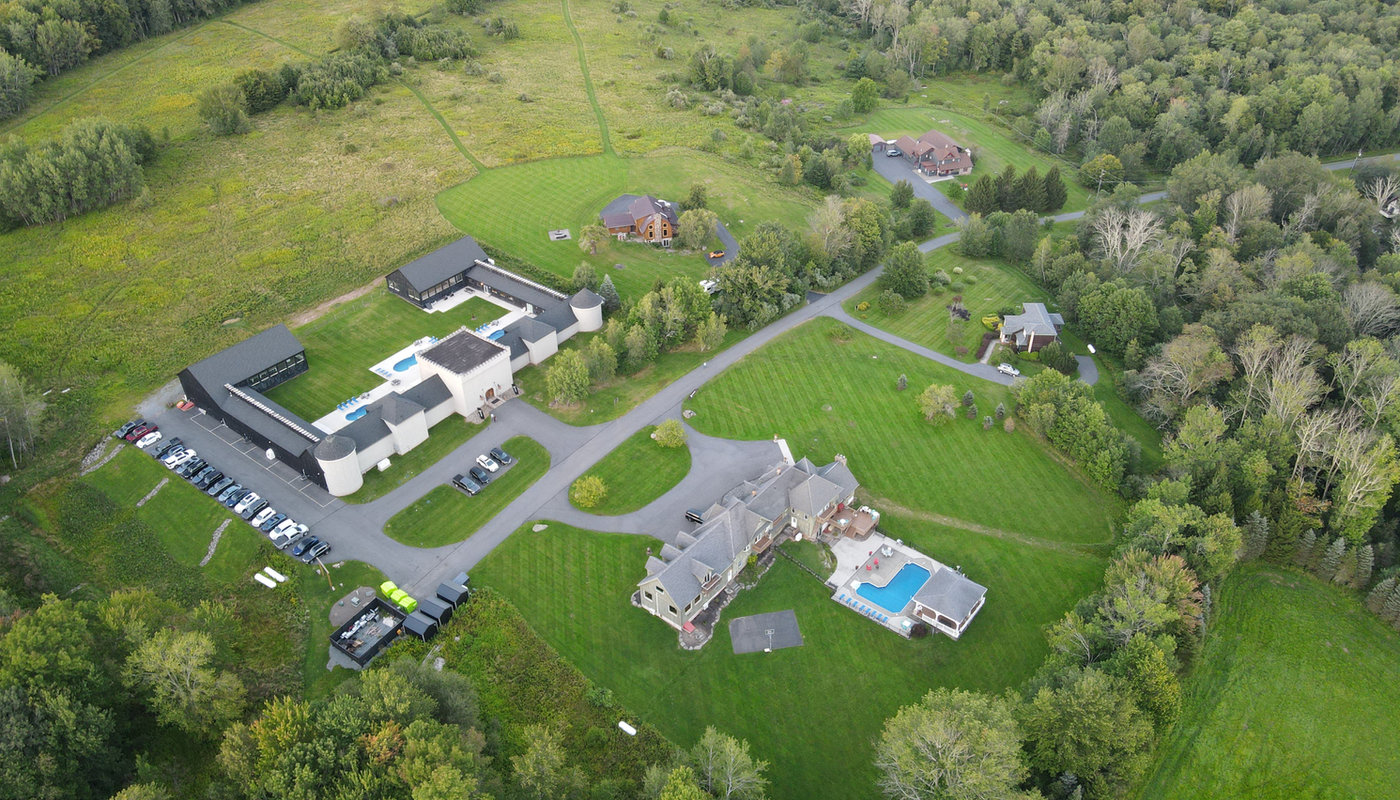
At Hilltop that means four homes across 130 private acres in the Poconos, roughly two hours from Manhattan and drivable from Newark, JFK, LaGuardia and Wilkes-Barre/Scranton. The War Room seats 60 with another 40 chairs available, so the whole group fits even at full capacity. A 72-seat theater with a 17-foot screen, 4K projector and stage. A 36-seat conference room at the Mansion. Two side-by-side candlepin bowling alleys, indoor and outdoor courts, pickleball, five pools (four outdoor, one heated indoor), and private hiking trails. The Castle alone has 26 bathrooms across 18 bedrooms — roughly one per 1.7 guests at full occupancy, against the one-per-four rule of thumb above. Nobody else on the property. We have run this for teams of 5 and teams of over 100.
The Castle also houses Legend of the Lost Kingdom, an escape-room game built into the building itself. Twelve hidden rooms across 30,000 square feet, each holding a clue, a challenge or a piece of the story. Teams split up and race to solve it. It runs 60 to 90 minutes and needs no facilitator or setup. Video of it here. Separately, facilitators can come in to run murder mysteries, scavenger hunts across the 130 acres, Family Feud and custom programs built around your team.
Where we are not the answer: if your team is genuinely distributed across the country, the driving advantage disappears and a city hotel closer to an airport may make more sense. And if the point of the offsite is restaurants and nightlife, we are two hours from all of it.
Strong on
- Exclusive use, always
- Meetings and recreation in one place
- Priced by building, not per head
- Works in any season and any weather
- An escape room built into the building itself
Weak on
- Rural setting, so no city nightlife
- Requires driving for most teams
- Not a fit for fully distributed teams
Teams that have run their offsite here
Across group sizes from five-person leadership retreats to all-hands gatherings of more than a hundred.
Common questions
Private compounds are typically priced per building per night rather than per person, with midweek nights discounted against weekends. The rate is flat across a building's capacity and steps up when the group outgrows it — at Hilltop, teams of 20 and 40 both take just the Castle, around 70 adds the Mansion, and 90+ takes all four buildings. Catering, facilitated team building, guided hikes, yoga, bartending and entertainment are quoted separately. The all-in for a group frequently lands below a conference resort quoting per-person day rates plus a room block plus meeting room rental.
For groups over 30, six to twelve months is realistic, and September through early November books earliest. Midweek dates are both cheaper and easier to secure — moving an offsite from a weekend to a Tuesday-through-Thursday is the single largest lever most planners have on cost and availability at once.
Above roughly 25 to 30 people, hotel blocks stop working well — the group loses common space and disperses into the property's public areas. Above 40 you generally need a dedicated multi-building property. Above 70 you need a purpose-built compound, and very few properties operate at that scale.
Hilltop is in Beach Lake, Pennsylvania — about two hours from Midtown Manhattan, two hours from Philadelphia, and within driving range of Newark, JFK, LaGuardia and Wilkes-Barre/Scranton. Most teams drive or charter a single bus rather than fly.
Many cannot do both well. When vetting, confirm there is a room that seats your full headcount for a working session with reliable wifi and a screen, plus recreation on the same property — so the group never has to convoy somewhere else between sessions. See our on-site activities for what that looks like in practice.
Ask any venue what the group does on a rainy day in November before you book — outdoor-dependent venues have no answer. Indoor recreation is what makes a property work in any season: a theater, bowling, indoor courts, a heated indoor pool, and multiple large common rooms.
Bring the whole team, and have the place to yourselves
Four private homes on 130 acres in the Poconos, two hours from Manhattan. Meeting space, recreation, and no other guests — for teams of 5 to 100+.